
Introduction
Full front PPF is usually the best value for daily drivers because it protects the areas most exposed to rock chips, road debris, bugs, and highway damage: the front bumper, hood, fenders, mirrors, and sometimes headlights. Full body PPF gives the most complete protection, but it costs more and is usually best for luxury cars, matte paint, exotic vehicles, long-term ownership, or owners who want maximum peace of mind.
The right choice depends on how you drive, where you park, your vehicle value, paint type, budget, and how long you plan to keep the car. A commuter sedan, a weekend sports car, and a matte-painted luxury SUV do not need the same PPF coverage.
Actual performance varies by film type, product specification, installer quality, vehicle condition, driving environment, and local climate.
Why PPF Coverage Choice Matters
Paint protection film is not a one-size-fits-all purchase. Many buyers start by asking whether PPF is worth it, but the more useful question is: which parts of the car actually need protection?
That question matters because most road damage is not evenly distributed across the vehicle. The front bumper, hood, front fenders, mirrors, rocker panels, lower doors, and rear wheel impact areas often face more abuse than the roof or upper rear quarter panels. Highway speed, tire spray, gravel roads, construction zones, winter salt, and track use can all change the risk level.
3M describes paint protection film as a protective film used to help protect vehicle finishes from chips, scratches, and outdoor weather exposure.
But coverage still matters. A high-quality PPF installed only on low-risk areas will not protect the parts that actually get hit. A full body install gives broader protection, but not every driver needs that level of investment.
For a wider explanation of PPF value and ownership factors, you can also read BEIKAER.
What Is Full Front PPF?
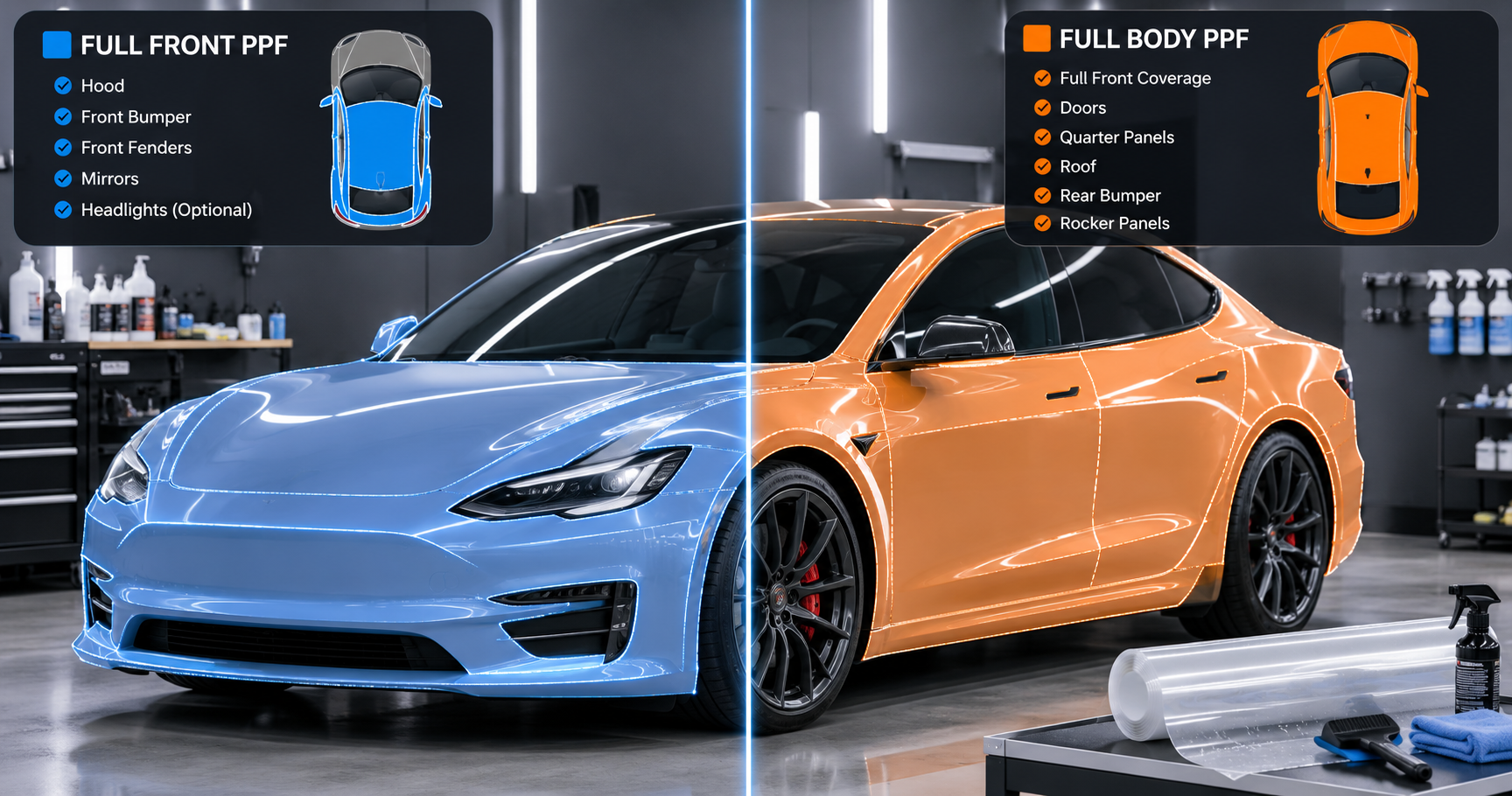
Full front PPF normally protects the forward-facing impact areas of the vehicle. A typical full front package may include the full hood, full front bumper, full front fenders, side mirrors, and sometimes headlights or A-pillars depending on the installer and package.
This is different from a partial front package, which may cover only part of the hood and part of the fenders. Partial coverage can reduce cost, but it may leave visible film lines and unprotected paint in areas that still receive impact.
Full front PPF is popular because it targets the highest-risk zones without covering every painted panel. For many daily drivers, it is the practical middle ground between doing nothing and paying for full body coverage.
It is especially useful for:
New vehicles driven daily
Highway commuters
EVs and sedans with low front bumpers
SUVs exposed to winter road salt and gravel
Sports cars with wide front ends
Owners who want protection without full-body cost
If you are comparing installation methods, this BEIKAER guide may help.
What Is Full Body PPF?
Full body PPF covers nearly all painted exterior panels. Depending on the vehicle and installer, this may include bumpers, hood, fenders, doors, roof, trunk, quarter panels, rocker panels, mirrors, and other painted surfaces.
Full body PPF is the most complete option because it protects more of the vehicle from scratches, scuffs, stains, wash marks, and environmental exposure. It can also help keep the vehicle’s paint finish more consistent over time because the entire car is covered with the same film type.
However, full body PPF is also more expensive, more labor-intensive, and more dependent on installer skill. Complex curves, edges, badges, parking sensors, trim pieces, and body lines all affect installation difficulty.
3M notes that PPF installation cost depends on factors including vehicle size, coverage options, and the type of film selected.
That is why full body PPF is usually chosen by owners who have a strong reason to protect the entire vehicle, not simply because it is the most expensive package.
Full Front PPF vs Full Body PPF: Main Difference
The main difference is coverage strategy.
Full front PPF protects the most vulnerable impact zones. It is the value-focused option for drivers who want protection where road debris is most likely to hit.
Full body PPF protects nearly the entire painted exterior. It is the maximum-protection option for owners who want broader defense against scratches, stains, washing marks, and long-term wear.
A simple way to think about it:
Full front PPF protects against the most common road damage.
Full body PPF protects against both road damage and broader ownership damage.
Ownership damage includes things like bag scratches near doors, fingernail marks near handles, careless washing, garage rubs, leaning against the car, pet claws, road tar, tree sap, bird droppings, and small scuffs in unexpected areas.
When Full Front PPF Makes the Most Sense
Full front PPF makes sense for most normal daily drivers. If your main concern is rock chips on the bumper and hood, full front coverage gives strong practical value.
It is also a good fit when the vehicle has standard gloss paint, replacement body panels are not unusually expensive, and the owner wants protection without turning PPF into a major investment.
For many buyers, the front of the vehicle is the area they notice first. Chips on the bumper, hood edge, and mirrors can make a relatively new car look aged quickly. Full front PPF directly addresses that concern.
Full front is also easier to justify when the car is leased or kept for a medium ownership period. You may not need to protect every panel if you plan to sell or trade the car in a few years, but protecting the front end can still help preserve appearance.
When Full Body PPF Is Worth Considering
Full body PPF becomes more attractive when the vehicle is expensive, rare, difficult to repaint, or personally important to the owner.
It is especially worth considering for matte paint. Matte factory paint is harder to repair consistently because polishing can change the surface appearance. If a matte panel is scratched or stained, repair can be more complicated than with gloss paint. Full body matte PPF can help preserve the original finish while keeping the appearance consistent.
Full body PPF may also make sense for black cars and other soft or dark paints that show scratches easily. It can be useful for owners who hand wash frequently but still worry about swirl marks and towel marks.
Consider full body PPF if:
You own a luxury, exotic, or performance vehicle
The paint is matte, satin, frozen, or specialty finish
You plan to keep the car for many years
You park in tight garages or public lots
You want maximum protection against daily wear
You want easier long-term cosmetic preservation
For owners comparing PPF with other protection methods, see BEIKAER.
What About Track Pack or High-Impact Packages?
Some installers offer coverage between full front and full body. These packages may be called track pack, high-impact package, driver package, or extended front coverage.
A typical high-impact package may add rocker panels, lower doors, rear wheel impact areas, A-pillars, roof edge, trunk ledge, or luggage areas to a full front package. This can be a smart upgrade for performance cars, wide-tire vehicles, and cars driven on rough roads.
Track-focused drivers should think beyond the front bumper. Sticky tires can throw debris onto rocker panels and rear quarter areas. Wide-body cars may also collect impacts in places a normal commuter car does not.
A high-impact package is often the best compromise for drivers who want more than full front protection but do not want to pay for full body PPF.
Partial Hood vs Full Hood: Why It Matters
Partial hood PPF can reduce cost, but it may leave a visible line across the hood. On some colors and under certain lighting, that line can collect wax, dust, or dirt and become noticeable.
A full hood install avoids the mid-panel film line and protects the entire hood. It also looks cleaner on luxury cars, dark paint, and vehicles with large flat hoods.
Partial hood coverage may still be acceptable for budget-focused owners, older vehicles, or drivers who mainly want basic chip protection. But for a new vehicle, full hood coverage is often the better long-term choice because it looks more natural and protects more paint.
This is one reason full front PPF is commonly preferred over older “clear bra” style partial kits.
Does Full Body PPF Replace Ceramic Coating?
Full body PPF does not fully replace ceramic coating because they serve different purposes. PPF is a physical barrier. Ceramic coating is a surface treatment that can improve ease of cleaning, water behavior, and surface slickness depending on the product.
Some owners apply ceramic coating over PPF to make washing easier. However, coating should not be applied underneath PPF unless the installer specifically prepares the surface correctly. 3M states that ceramic coating should be professionally removed before applying paint protection film, while ceramic coating may be applied on top of 3M PPF depending on installer guidance.
In practical terms, choose PPF first if your concern is chips and scratches. Choose ceramic coating if your concern is easier washing and water behavior. Combine them when you want both impact protection and easier maintenance.
Maintenance Differences Between Full Front and Full Body PPF
Full front PPF is easier to maintain because fewer panels are covered. You only need to monitor the protected front areas, edges, and exposed seams.
Full body PPF requires more consistent care because every panel has film edges, curves, and surfaces to maintain. It is not difficult, but the owner should wash carefully and avoid harsh products.
LLumar recommends waiting 72 hours before washing newly installed PPF and says hand washing with soap, water, and a soft clean cloth is preferred. It also discourages pressure washing and automatic car washes because they can cause lifting, especially around film edges.
This matters because even premium PPF can be damaged by poor washing habits. Film quality and installer skill are important, but maintenance still affects long-term appearance.
How to Choose the Right PPF Coverage
Start with your vehicle value and risk level. A high-mileage commuter may only need full front coverage. A luxury SUV parked outdoors may benefit from full front plus rocker panels and door edges. A matte-painted performance car may justify full body PPF.
Then consider your driving environment. If you drive mostly in the city at low speed, your front-end chip risk may be lower. If you spend hours on highways, mountain roads, construction zones, or winter roads, front and lower-body protection becomes more important.
Finally, match the package to your expectations. If you will be upset by scratches anywhere on the car, full body PPF may be the only option that fits your mindset. If you mainly want to prevent obvious front-end chips, full front PPF is usually enough.
A good installer should help you choose based on vehicle shape, paint condition, use case, and budget rather than pushing only the most expensive package.
FAQ
Is full front PPF enough for a daily driver?
For many daily drivers, full front PPF is enough because it protects the areas most likely to receive rock chips and road debris damage. This usually includes the bumper, hood, fenders, mirrors, and sometimes headlights. It is not complete protection for the entire car, but it offers strong value for normal commuting, highway use, and new car preservation.
Is full body PPF worth it?
Full body PPF can be worth it for luxury cars, matte paint, exotic vehicles, black cars, long-term ownership, and owners who want maximum cosmetic protection. It is less necessary for every daily driver because the cost is much higher than full front coverage. The decision depends on vehicle value, paint type, driving environment, budget, and how sensitive you are to scratches or stains.
What is the difference between partial front and full front PPF?
Partial front PPF usually covers only part of the hood and fenders, plus the bumper and mirrors depending on the package. Full front PPF usually covers the full hood, full front fenders, bumper, and mirrors. Full front coverage looks cleaner because it avoids mid-panel film lines and protects more paint.
Should I get PPF on rocker panels?
Rocker panels are worth protecting if you drive on gravel roads, winter roads, construction areas, or own a performance car with wide or sticky tires. These lower panels can receive debris thrown from the front tires. Rocker panel PPF is a smart add-on for drivers who want more protection than a basic full front package.
Can PPF be removed later?
Quality PPF is generally designed to be removable by trained professionals, but removal results depend on film age, paint condition, installation quality, climate exposure, and whether the vehicle has been repainted. Do not pull old film aggressively by yourself, especially on repainted panels or aged paint. Professional removal helps reduce the risk of adhesive residue or paint damage.
Conclusion
Full front PPF is the best choice for many daily drivers because it protects the highest-impact areas without the cost of covering the entire vehicle. Full body PPF is the premium option for owners who want maximum protection, especially on luxury vehicles, matte paint, performance cars, and long-term ownership builds.
The smartest choice is not always the biggest package. It is the package that matches your real driving conditions, vehicle value, paint type, and expectations. For some owners, full front PPF is the perfect balance. For others, full body PPF provides the peace of mind they are looking for.
Choose a quality film, work with an experienced installer, and maintain the film properly. That combination matters more than coverage alone.