
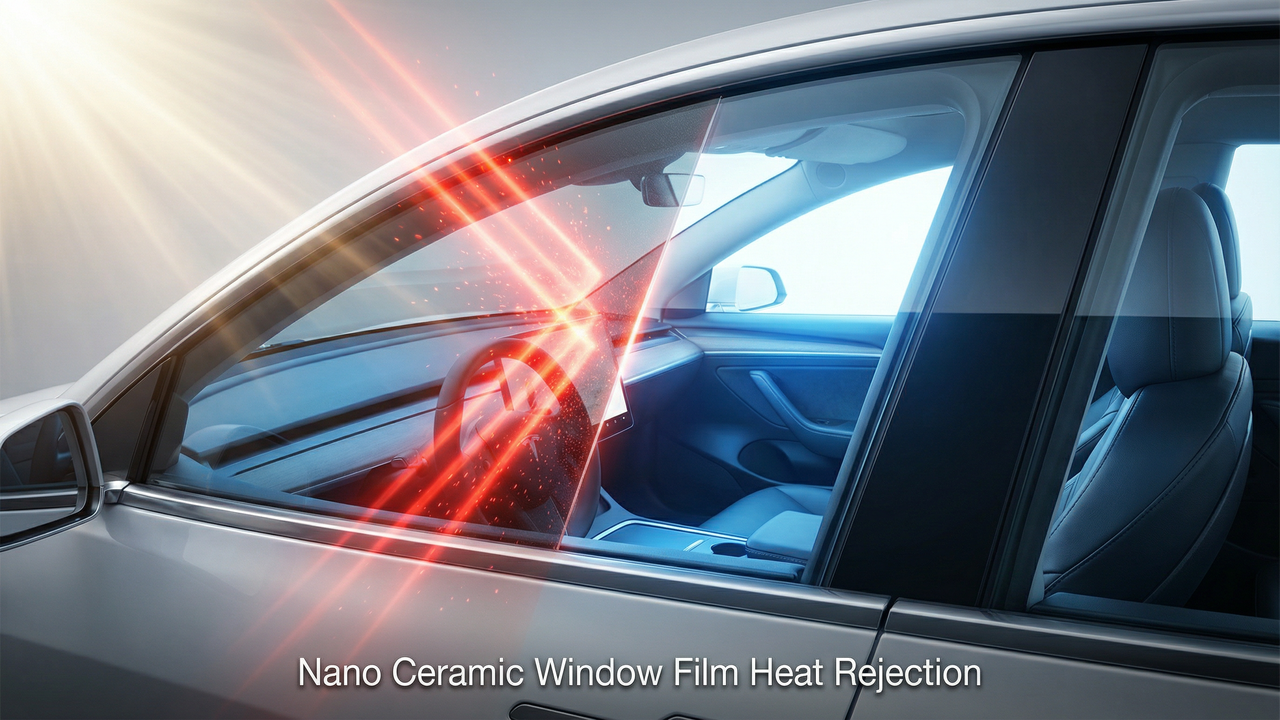
What Is Nano-Ceramic Window Film?
Nano-ceramic window film is a premium category of automotive and architectural tint that uses advanced ceramic particles to block heat, glare, and UV radiation. Unlike traditional dyed or metallic films, nano-ceramic films are non-metallic, non-conductive, and highly durable, offering superior optical clarity and thermal performance.
The Science Behind Heat Rejection
Heat rejection in window films involves two primary mechanisms:
- Infrared (IR) Radiation Blocking
- Ultraviolet (UV) Radiation Filtering
Nano-ceramic films are engineered with microscopic ceramic particles that selectively block infrared radiation, which is responsible for up to 50% of solar heat. These particles do not interfere with visible light, allowing for high transparency while maintaining thermal insulation. For a deeper dive into practical car protection strategies, check out Car Protection Film Tips on our blogs.
Infrared Radiation and Its Role
Infrared radiation lies in the wavelength range of 700 nm to 2500 nm. Nano-ceramic films are designed to absorb and reflect IR waves, significantly reducing the amount of heat that penetrates through glass.
According to a study published in Light: Science & Applications by Jiang et al. (2024), thermochromic coatings like vanadium dioxide (VO2) can dynamically regulate heat gain by undergoing a metal-to-insulator transition (MIT), altering their optical properties in response to temperature changes [1]. While VO2 is a specific material, the principle of selective IR modulation is foundational to nano-ceramic film technology.
Key Benefits of Nano-Ceramic Films
- High IR Rejection: Blocks up to 90% of infrared radiation.
- UV Protection: Filters over 99% of harmful UV rays.
- No Signal Interference: Unlike metallic films, ceramic films do not block GPS, mobile, or radio signals.
- Optical Clarity: Maintains visibility without the hazy or reflective appearance.
- Durability: Resistant to fading, bubbling, and discoloration.
Common Misconceptions
1. “Dark Tint Equals Better Heat Rejection”
This is false. Heat rejection depends on IR blocking, not visible light absorption. Nano-ceramic films can be nearly clear and still outperform darker dyed films.
2. “All Ceramic Films Are the Same”
Not all ceramic films use nano-scale particles. Nano-ceramic films offer finer particle dispersion, leading to better performance and clarity.
Why It Matters for Consumers
In hot climates or urban environments, effective heat rejection can:
- Reduce air conditioning load
- Improve fuel efficiency (for vehicles)
- Enhance indoor comfort
- Protect interiors from UV damage
Conclusion
Nano-ceramic window films represent the cutting edge of heat rejection technology. By leveraging advanced materials science, these films offer superior thermal insulation without compromising visibility or connectivity. Whether you’re upgrading your car or your home, understanding the true mechanism behind heat rejection helps you make an informed choice. If you want to read more about other protection films, for example, self-healing Paint Protection Films(PPF), you can check out our latest blogs for more information.
Sources:
[1] Jiang, C., He, L., Xuan, Q., Liao, Y., Dai, J.-G., & Lei, D. (2024). Phase-change VO2-based thermochromic smart windows. Light: Science & Applications, 13(255). https://doi.org/10.1038/s41377-024-01560-9