
Introduction
Paint Protection Film (PPF) has become one of the most sought-after automotive innovations in recent years. Car enthusiasts and everyday drivers alike are drawn to its promise of keeping vehicles looking pristine, even after years of exposure to environmental hazards. But what truly sets PPF apart is its self-healing ability and its remarkable scratch resistance. These features are not marketing gimmicks; they are rooted in material science and polymer engineering. In this article, we will explore the scientific principles behind PPF’s performance, examine why it works, and provide credible references to back up these claims.
For practical tips on car protection films, you can also check out our dedicated guide.
What Is Paint Protection Film?
Paint Protection Film is a transparent polyurethane-based film applied to the exterior surfaces of a vehicle. Originally developed for military use to protect helicopter blades from debris, PPF has evolved into a consumer product designed to safeguard automotive paint.
Modern PPF is typically made from thermoplastic polyurethane (TPU), a polymer known for its elasticity, durability, and resistance to abrasion. TPU’s unique molecular structure is the foundation of PPF’s self-healing and scratch-resistant properties.
The Science of Self-Healing
1. Thermoplastic Polyurethane (TPU) Structure
TPU is composed of alternating soft segments and hard segments. The soft segments provide flexibility, while the hard segments offer strength and durability. This dual-phase structure allows TPU to absorb minor damage and then “rearrange” itself under heat or pressure.
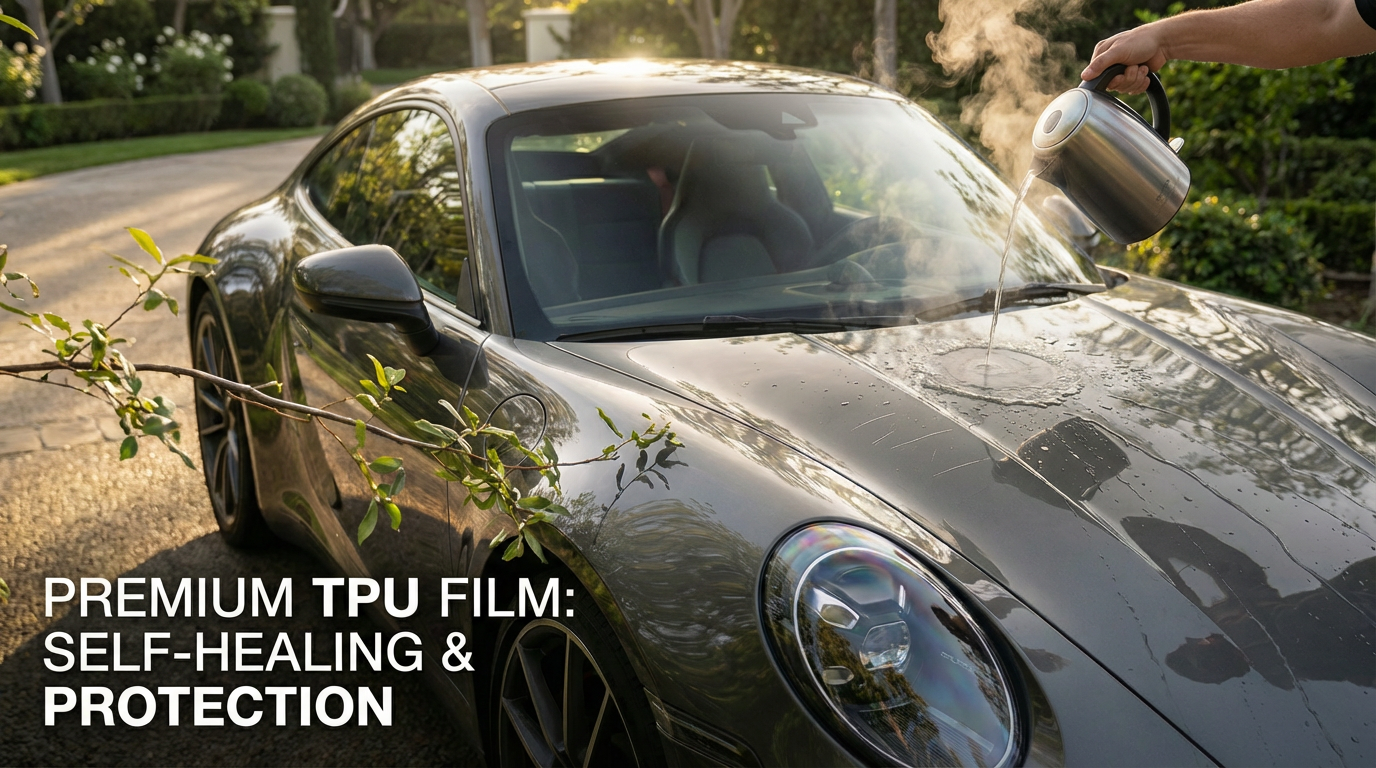
When a scratch occurs, the polymer chains are temporarily displaced. Exposure to heat—whether from sunlight, hot water, or even ambient temperature—provides the energy needed for the chains to return to their original configuration. This is why PPF can “heal” light scratches and swirl marks.
Scientific reference: Researchers have demonstrated that TPU exhibits shape memory and self-healing properties due to reversible hydrogen bonding and segmental mobility in its polymer chains (see Polymer International Journal on TPU self-healing mechanisms).
2. Heat Activation
Self-healing in PPF is typically triggered by heat. When the film warms up, the polymer chains gain mobility, allowing them to realign and close surface-level scratches. This is why many PPF manufacturers recommend pouring warm water over scratched areas or simply parking the car in the sun.
Example: A study published in Progress in Organic Coatings highlights how heat-induced polymer mobility contributes to scratch recovery in polyurethane coatings.
3. Elastic Recovery
Beyond heat, TPU’s inherent elasticity plays a role. When scratched, the film stretches slightly. Once the force is removed, the material contracts back to its original state, minimizing visible damage.
This elastic recovery is similar to how memory foam returns to shape after compression, but at a molecular level.
Scratch Resistance Explained
1. Surface Hardness
PPF is engineered to resist scratches through its surface hardness. While not as hard as ceramic coatings, TPU provides a balance between flexibility and toughness. The hard segments in TPU act like armor, dispersing the force of abrasions across a wider area.
According to Materials Science and Engineering Journal, TPU films demonstrate high abrasion resistance compared to conventional polymers, making them ideal for protective applications.
2. Energy Absorption
When a sharp object contacts the film, TPU absorbs and dissipates the energy rather than transferring it directly to the paint. This prevents deep scratches from forming on the underlying surface.
This property is particularly useful against everyday hazards such as car washes, road debris, and accidental brushes with shopping carts.
3. Multi-Layer Construction
Many premium PPF products are multi-layered, combining a topcoat with enhanced scratch resistance and a base layer for adhesion. The topcoat often includes hydrophobic properties, making the film resistant to water spots and stains.
Example: 3M and XPEL, two leading PPF manufacturers, highlight multi-layer TPU construction as the reason their films resist scratches and environmental damage.
Real-World Applications
Automotive Industry
PPF is widely used in luxury and sports cars, where maintaining flawless paint is crucial for resale value. Owners of brands like Tesla, BMW, and Porsche often invest in full-body wraps to protect their vehicles.
Military and Aerospace Origins
PPF’s roots in military applications underscore its durability. Helicopter rotor blades and fighter jet surfaces were among the first beneficiaries of polyurethane films, proving their resilience in extreme conditions.
Limitations of PPF
While PPF offers remarkable protection, it is not invincible. Deep gouges or cuts cannot be healed, and the film itself may need replacement after several years. Additionally, improper installation can lead to bubbling or peeling.
However, when properly applied and maintained, PPF can last 5–10 years, depending on environmental exposure.
Conclusion
Paint Protection Film is more than just a transparent shield—it is a marvel of polymer science. Its self-healing ability stems from the molecular mobility of TPU, while its scratch resistance is a product of surface hardness, elasticity, and multi-layer construction.
For car owners, PPF represents a smart investment in preserving both aesthetics and value. And for those curious about practical tips on choosing and maintaining PPF, don’t forget to explore our guide: Car Protection Film Tips.
By understanding the science behind PPF, you can appreciate why this technology has become a cornerstone of modern automotive care.