
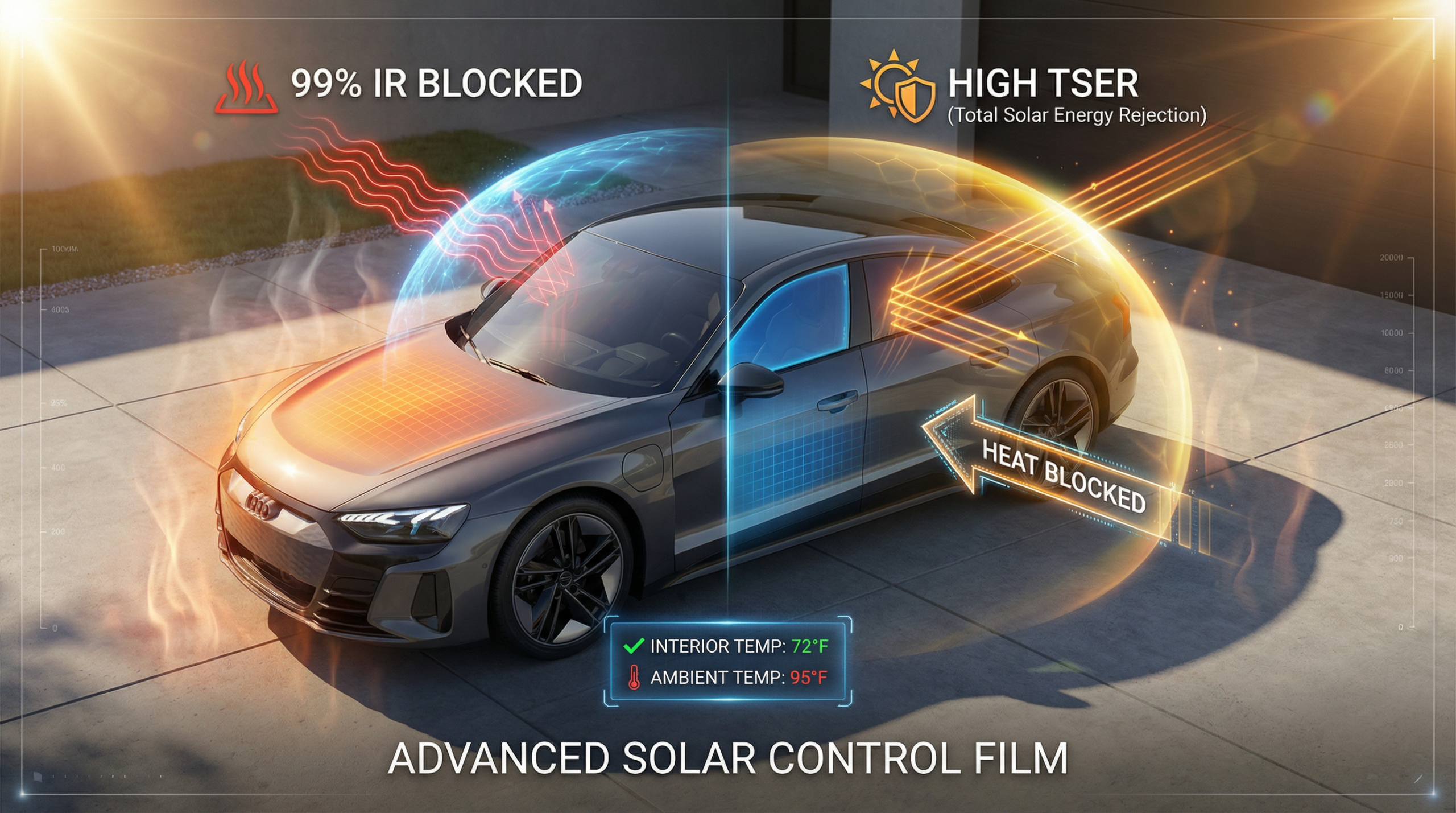
If you’ve ever shopped for car window tint, you’ve seen it:
“99% IR Rejection!”
It sounds like your cabin will turn into an icebox. But many drivers discover that after installation, the car still feels hot. Why? Because not all infrared claims are measured the same way, and not all heat comes from the same part of the solar spectrum.
This guide explains—clearly and scientifically—what actually matters: TSER vs IRR, how some numbers can be misleading, and how to choose tint based on real performance rather than marketing slogans.
What You’ll Learn
- The real difference between TSER and IRR
- Why “99% IR” can still feel hot in real driving
- Which testing standards make specs trustworthy
- How to read a tint spec sheet like a pro
- Where most heat enters your vehicle
- UV protection facts many drivers overlook
TSER vs IRR: Understanding the Basics
TSER – Total Solar Energy Rejected
TSER measures how much total solar energy is blocked by the film and glass combined.
It considers ultraviolet, visible light, and infrared energy together—the same mix that heats your car.
Because it looks at the full spectrum, TSER is the closest single number to real-world comfort. A higher TSER generally means a cooler cabin, less AC load, and better overall performance.
IRR – Infrared Rejection
IRR only measures infrared blocking, but here’s the catch:
Some brands report IRR at a very narrow wavelength or even at one single point. That can make a film look amazing on paper while ignoring other parts of the spectrum that still generate heat.
So two films can both claim “99% IR” yet perform very differently inside a vehicle.
Why 99% IR Can Still Feel Hot
Solar energy hitting your car spans roughly 300–2500 nm.
Heat doesn’t come from one single infrared point—it’s spread across a wide range.
If a product advertises:
“99% IR rejection at 940 nm”
That doesn’t mean it blocks 99% of all infrared energy. It only means 99% at that specific slice. Large portions of heat can still pass through at other wavelengths.
This is why experienced installers and detailers focus on TSER first, IR numbers second.
The Standards That Make Specs Credible
Not all spec sheets are created equal. Trust increases when results reference recognized methods.
ISO 9050
International method for determining solar and optical properties of glazing. It provides a structured way to calculate energy transmission rather than marketing estimates.
NFRC 300
Widely used in the glazing industry to determine solar optical performance. Labs aligned with NFRC procedures tend to deliver more consistent and comparable results.
When a manufacturer references real standards instead of only a glossy chart, the data is far more reliable.
How to Read a Tint Spec Sheet (No Sales Tricks)
1. Start With TSER
If TSER isn’t published, ask why.
It’s the most honest indicator of cabin heat reduction.
2. Question IRR Claims
Always ask:
- At what wavelength?
- Over what range?
- Measured by which lab?
“IR 99%” without context is almost meaningless.
3. Understand VLT
VLT (Visible Light Transmission) = how dark the film looks.
Darker does not automatically mean cooler.
High-quality ceramic films can reject significant heat even at lighter shades.
4. Don’t Forget UV
Factory glass often blocks UV-B well, but UV-A protection can vary greatly, especially on side windows. Tint can standardize and improve real UV defense for skin and interior materials.
Where Heat Really Enters Your Car
Many drivers assume side windows are the main problem, but in real use:
- The windshield often delivers the biggest heat load
- Front cabin glass receives the most direct sun
- Rear glass matters more in certain climates and seating positions
A balanced approach usually works better than simply going darker on the sides.
Practical Buying Strategy
- Compare TSER at your preferred VLT
- Use IR numbers only as secondary confirmation
- Check whether results reference ISO/NFRC methods
- Consider climate, commute time, and visibility needs
- Think windshield + front cabin first for comfort
Frequently Asked Questions
Is TSER the best number to compare window tint?
For most drivers, yes. TSER is the best single metric that reflects real heat reduction because it measures total solar energy rather than one narrow band.
Why do some films show 99% IRR but low TSER?
Because IRR can be measured at a selected wavelength, while TSER represents performance across the full solar spectrum that actually heats your car.
Does darker tint always reject more heat?
No. Darkness is about visible light. Heat rejection depends on spectral technology and is better represented by TSER than by shade alone.
Do I still need UV protection if my car has factory glass?
Yes. Side windows often allow more UV-A than windshields. Adding quality film helps standardize protection for skin and interior materials.
The Bottom Line
Marketing loves big IR numbers.
Your comfort depends on total energy management.
When you evaluate window tint based on TSER first, IRR with context, and real testing standards, you avoid disappointment and choose a film that actually works in daily driving—not just on a brochure.
If you’d like help comparing options for your vehicle and climate, feel free to reach out. We’re happy to translate specs into real-world results. Looking for the best place to get this kind of film? We’re here to help. Discover more about Heat Rejection Film on our website.
